Meet Sheila Jack MSGLD
From art director at US Vogue and Harper's Bazaar to one of London's most sought-after garden designers, Sheila Jack's career path is as distinctive as her gardens. Her contemporary, naturalistic schemes have earned her SGLD Awards, a Chelsea Flower Show collaboration and a place on House & Garden's Top 50 Garden Designers list, two years running.
Images by Éva Németh from ‘Wonderlands: British Designers at Home’ by Clare Coulson.
1. What types of gardens do you typically design and how would you describe your design style in three words?
I would say the projects aim to be quietly elegant, contemporary gardens characterised by a genuine sensitivity to the existing landscape, deceptively simple layout, a wealth of form and texture, uncompromising attention to detail and immersive, naturalistic planting. Many projects are in London, often tricky logistically, with compromised light conditions and valuable outside space at a premium. Latterly, there has also been the opportunity to design more country projects including an estate in Wiltshire, and a five acre property in Umbria
2. What's the first thing you consider when starting a new garden project?
Aside from the client brief the starting point is always context - sense of place, architecture, light, sustainability, improving biodiversity, available soil conditions
3. Where do you draw your creative inspiration from?
Inspiration is everywhere - gardens and landscapes obviously but also exhibitions, art galleries & museums, architecture, books, walking around London or travelling, craftspeople, conversations...
4. How central is sustainability to your design process, and how does that look in practice? Are there any plants or materials you've stopped specifying because of their environmental impact?
Sustainability is at the heart of the design thinking. It’s increasingly essential to select resilient, site appropriate plant species, for example, in London, I am avoiding the more ‘thirsty' plants such as some types of Hydrangea. I am much more aware of utilising 'site won' materials or recycling ‘waste' within the garden, using less concrete, permeable subbases and joints, working with existing soil, installing ways of rainwater harvesting & reuse and encouraging clients to wean their new plants off irrigation after the initial period
5. What's your all-time favourite planting combination, and why does it work so well?
So many wonderful planting permutations but as I tend towards a naturalistic aesthetic, meadow inspired matrix planting can work well using a relatively shade tolerant grass like Sesleria autumnalis in combination with multi stemmed trees. Adding layers of perennials and bulbs which flower in succession means that there is always something of interest beginning with Narcissus, Tulips, then Camassia, repeated clumps of Iris sibirica or Amsonia, then Lilium martagon and finally swathes of Succisa pratensis, Devils bit scabious - tiny lavender bobble heads on wiry stems held above the seedbeds of the Sesleria take the scheme into Autumn
6. Do you have a go-to colour palette, or does it change with each project?
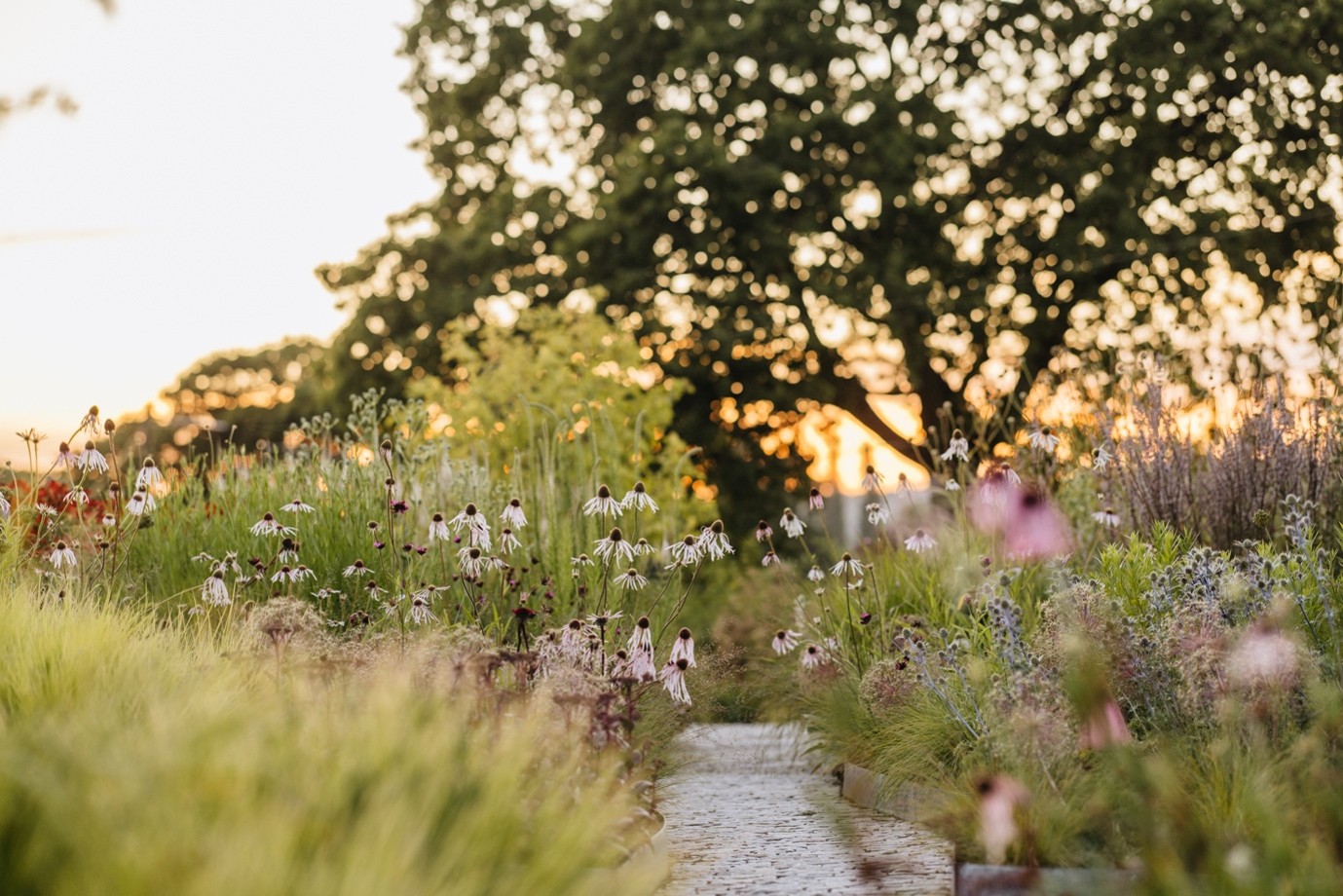
Recently,I have gravitated towards pale pinks, blues with a jolt of something dark, a sprinkling of bright or bold and a pale, pale yellow. However, palette choice is always a response to the client brief, the architecture, to the surroundings, the movement of light across a garden space etc etc. I would always try to think beyond what the plant looks like in flower - its form, texture, leaf shape, seed heads or hips etc and how that changes throughout the year - the actual 'in flower' moment can be so brief but the plant can contribute to the overall garden year round and seasonal change so important
7. Is there a plant you think is underused in British gardens?
Whilst there are amazing nurseries in this country, sometimes it feels like we are restricted by what can be easily sourced. For example, James Hitchmough suggested this lovely looking Echinacea - Echinacea tennesseenis, shorter than the usual as an occasional low emergent on the edges of planting but I’ve yet to find a UK supplier
8. What's the single biggest impact a homeowner can make to refresh a tired garden?
There is always merit in really considering what is already there. Often when we come to a garden there is already a beautiful mature tree or shrub but somehow it is lost - could you prune to reshape it? lift the canopy or clear other planting to refocus the eye?
9. What's a common mistake people make when trying to update their outdoor space?
I wish people didn’t assume they must have an expansive, highly maintained lawn (or worse, artificial grass) at the expense of planting or place an overly expansive terrace immediately adjacent to the house, only to fill it with furniture so that becomes your view rather than the softness of foliage and planting. So much more interesting if you used the height and relative “transparency” of a multi-stem tree even quite close to the house. The garden will be so much more inviting if you don’t see it all at once.
10. Which supplier(s) do you rely on most when sourcing plants or materials for clients?
I tend to deal with smaller UK based nurseries and source materials as locally as possible.
11. What's one tool or resource you couldn't design without?
Pencil - so much of the design work is computer based but everything starts with a pencil.
12. Which garden — anywhere in the world — has moved you most, and why?
Visiting Japan was revelatory and British gardens such as Dixter, Sissinghurst and Piet Oudolf’s Hauser & Wirth, Somerset are always inspiring, but I don’t see how anyone couldn’t be moved by Rousham. It is a quite magical exercise in restraint - the meandering rill, clipped laurel and control of dappled light. It is restful, actually quite compact but feels spacious, time-worn and beautifully paced. No matter how many times I visit, it always reveals something new.
13. What does your own garden look like?
We have a fairly typical size, rectangular London garden, planted simply with a predominantly green & white palette and a bigger plot in Wiltshire which benefits from the beautiful 'borrowed landscape' of the surrounding fields and mature oaks. Formerly a concrete yard, this has been an inspiring place to experiment with larger swathes of perennials and grasses
14. How do you feel about AI and garden design?
As designers, it is easy to feel threatened by AI but perhaps, like many technological changes across design disciplines, the real ‘risk' is not the technology itself, but how it is used. If AI is treated as a straight substitute for expertise or understanding rather than another tool to support it, you make the design process purely transactional rather than a dialogue. Good design is a collaboration, nuanced, contextual, emotive, sometimes the unexpected. I would prefer to view AI as an asset with the potential to support, freeing up time spent on some of the more repetitive tasks.
Return to the Meet a Designer Hub