Making a public realm space useable is essential for its success and at The McEwan, OOBE has balanced this with a need for sustainable, environmental enrichment.
During the course of Moda Living’s residential development of the former Scottish & Newcastle Brewery in Edinburgh, architect practice OOBE was brought in to work on the environmental enrichment of the site. As Mike Goodall, co-founder and Design Director of OOBE, explains, the prime objective was to strengthen the connections between key buildings and improve pedestrian and cyclist access along the main route that links the development with its surrounding area. ‘We also wanted to introduce a naturalistic planting scheme, honour the history of the site with a “springline” design concept referencing the importance of flowing water to the brewing process, and incorporate a graphic based on the heads of the barley that most beer is made from,’ he says.
Good visibility
‘The single biggest predictor of success for any public realm project is how well used the space is,’ says Mike. ‘Making people feel safe and welcome is dependent on factors including functionality and circulation, internal and external links between buildings, and making the space flexible for occasional events. It is also about natural surveillance [maximising visibility], so we developed a strong herbaceous layer, and kept shrubs to a minimum and to the sides of the sites to preserve open sightlines. The shrubs were emergent and open canopied in nature, to reinforce visibility.’
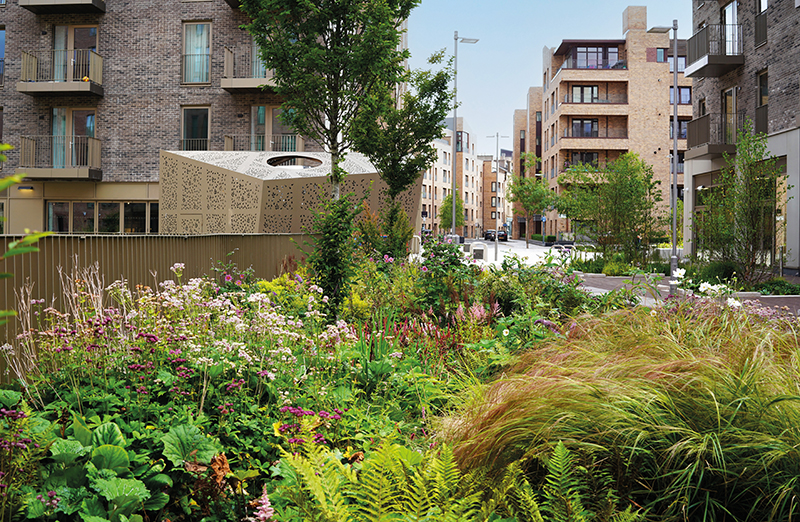
IMPERFECT TREES ARE A GREAT WAY TO ENHANCE THE NATURALISTIC CHARACTER OF A SCHEME.
Trusting the gardeners
The planting palette is a mixture of robust plants with complementary habits, a woodland character, and resilient, low-maintenance requirements. ‘Instead of drawing up formal planting plans,’ says Mike, ‘we prefer to meet the team on site to discuss the overall concept and set some general rules such as planting in groups of five, seven or nine, or avoiding positioning two groups of the same species next to each other. We give them freedom to interpret the concept on the ground and have found this to be very successful, reinforcing the naturalism, and giving the planters a real a sense of ownership and pride in the project.’
Expectations v reality
‘We placed great emphasis on “greening” the site,’ Mike continues. ‘We were able to retain a number of existing trees, and we specified additional native species with some yew hedging for winter structure. We actively try to promote the desirability of imperfect trees; it’s a great way to enhance the naturalistic character of our schemes.’
He is pragmatic about the financial realities of commercial projects, however. ‘Here, we included extensive SuDS gardens and used a range of widely tolerant species, but cost is always an issue. We are often caught in the middle of planning debates about natives for biodiversity and biodiversity net gain requirements, set against the need to propose adaptable species that can survive without long-term irrigation, but I am excited about a future where urban forests will, I hope, become the norm.’
oobe.co.uk
Words, Jodie Jones; photographs, OOBE
SUBSCRIBE TO THE GARDEN DESIGN JOURNAL NOW
Take out an annual subscription, or you can purchase one as a gift for a friend.