Urban tree cover is critical for the good health of humans and other species, but to ensure we have such a benefit in the future, the type of trees selected for cities needs to change. Hannah Gardner looks at the likely candidates
Securing the eco-system benefits of successful tree planting for the future relies on utilising recent research data. While the rate and unpredictability of climate change is quickly testing resilience, climate projections and studies in plant biology should inform selections of species that can survive and thrive, particularly in urban environments.
‘Urban trees are a frontline adaptation tool, providing cooling, shade, air quality improvements, stormwater regulation, and essential biodiversity support,’ says Kevin Martin, Head of Tree Collections at the Royal Botanic Gardens Kew, where he shoulders responsibility for its living tree collection. He is also a Research Fellow at the Urban Plant Lab, a not-for-profit organisation led by Directors Dr Andrew Hirons, Dr Henrik Sjöman, and Dr Harry Watkins, that was set up to aid people through research, guidance, events, and training in the selection and establishment of plants for urban environments.
Since 2015, the Lab team, together with various collaborators, has published a number of papers and books and in November 2025, it delivered its final report, Future Climate Suitability of London’s Public Realm Trees, which was commissioned by the Greater London Authority and the Forestry Commission to assess how trees planted in the public realms of Greater London and the City are likely to cope with projected climate conditions in 2090, and was co-authored by Dr Hirons and Kevin.
London is the first city in the world to commission such a comprehensive climate suitability assessment of its public trees. Although specific to Britain’s capital (the report’s authors stress that the findings 'should not be applied to other cities or regions, even within the UK, as climate projections and growing conditions vary substantially’), the findings are of interest in a wider context. Eighty per cent of people in England live in urban areas1, where trees are an essential infrastructure, and street trees account for a large proportion of that.
Working to a scenario whereby, by 2090 in London, the annual Potential Evapotranspiration (PET) value will be more than 750mm, with an annual precipitation count of 600mm and a mean annual temperature of 14C, the report finds that understanding a taxa’s projected growth rate and canopy structure matters as trees that efficiently cool the air will provide essential climate-regulating services as heat intensifies. However, they need the space in which to do so and, as the report’s conclusion states, ‘Climate risk to trees is further compounded by poor growing environments. Together, these factors present a substantial and strategic challenge for urban forest managers to address over the coming decades.’
EXPERT TIPS FOR ESTABLISHMENT AND LONGEVITY
‘Understand what you are trying to achieve,’ says Eliot Barden. ‘Select the right tree in the right place and, critically, for the right reason.’
Perform correct tree-planting practises: use the shallow-planting technique in square holes and allow sufficient root protection area as the tree matures. Carefully consider staking and irrigation during the establishment period, which should be at least two seasons.
‘Budget and plan for a full, proactive aftercare schedule before planting,’
says Guy Watts.
Disease resistance is also key. ‘Many familiar species have traits that leave them vulnerable to hotter, drier summers and prolonged heatwaves,’ says Kevin. ‘Their decline may not be immediate but over time, reduced growth, canopy dieback, and even premature mortality are likely.’
The models in the report also highlight species (both local and exotic) that have the physiological ‘toolkit’ to withstand the challenges of a changing climate, and its key findings highlight the scale of that task. If no changes to tree species selection are made, 73 per cent of London’s public trees may struggle to thrive or survive. Only 0.38 per cent of the capital’s currently existing trees are considered highly suitable for future climate conditions while 22 per cent of them are moderately suitable, 62 per cent are rated as having low suitability, and 10.6 per cent are considered vulnerable.
Trials for new plant material
While Future Climate Suitability of London’s Public Realm Trees is a call to arms to ‘strategically diversify London’s urban forest’, to ‘intentionally design excellent rooting environments for new trees [and] develop policies to ensure pathways for new plant material, well-matched to future climates, to be brought into cultivation’, it is a clarion call to key stakeholders in all Britain’s towns and cities.
Indeed, specialist nurseries are already pro-actively trialling new species. Barcham Trees, for example, has commissioned the Exeter-based social enterprise Treeconomics to analyse data gathered by internationally recognised systems such as i-Tree Eco methodology so the nursery can calculate the specific benefits of each taxa.
Following on from their awareness-raising presence at RHS Chelsea earlier this year, I asked both Eliot Barden, of Majestic Trees, and Guy Watts, of Architectural Plants, for their recommendations for climate-resilient tree selection and insights into tree establishment and management.
I then considered resilient taxa for specific situations, as this targeted approach may be useful for professional designers. Here is my selection.
URBAN TREES FOR CLIMATE RESILIENCE: THE EXPERT CHOICE
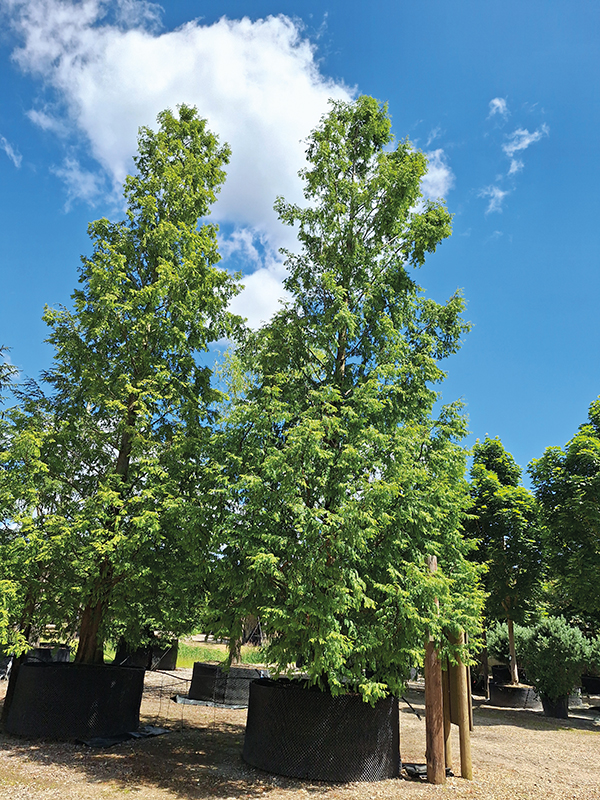
BEST FOR: SOIL COMPACTION
Metasequoia glyptostroboides
Dating back more than 65 million years although only in cultivation since the 1940s, the evolutionary longevity of this tree bodes well. The dawn redwood benefits from warm summers and requires moist soil for successful growth. Once established, it is tolerant of temporary water logging, air pollution, compaction and drought. A hardy, deciduous conifer, its fine foliage provides summer shade, and has an impressive bark and dramatic autumn colour. Magnificent as a solitary tree, street tree, or grouped.
Height: 17 to 22 metres; Spread: 2.5 to 4 metres.
BEST FOR: DROUGHT
Sorbus aria ‘Majestica’
RHS Recommended AGM
This whitebeam has exceptional drought tolerance, is pollution resistant and extremely resilient to wind, including coastal winds. It is hardy to -30C but requires good drainage. Sorbus provide several seasons’ worth of interest with spring flowers a vital food source for emerging pollinators and berries persisting into winter for birds. The silver-coloured leaves reflect sunlight and slow transpiration. Slow to establish.
Height: 8 to 12 metres; Spread: 4 to 8 metres.
BEST FOR: SCREENING
Elaeagnus x submacrophylla
RHS recommended AGM
A dense, hardy, drought-tolerant evergreen available in a variety of trained forms that ‘work very well when you are designing to spread risk’, says Guy Watts. Great as a tough, fast-growing screen or windbreak. Supports pollinators.
Height: 4 to 5 metres; Spread: 2.5 to 5 metres.
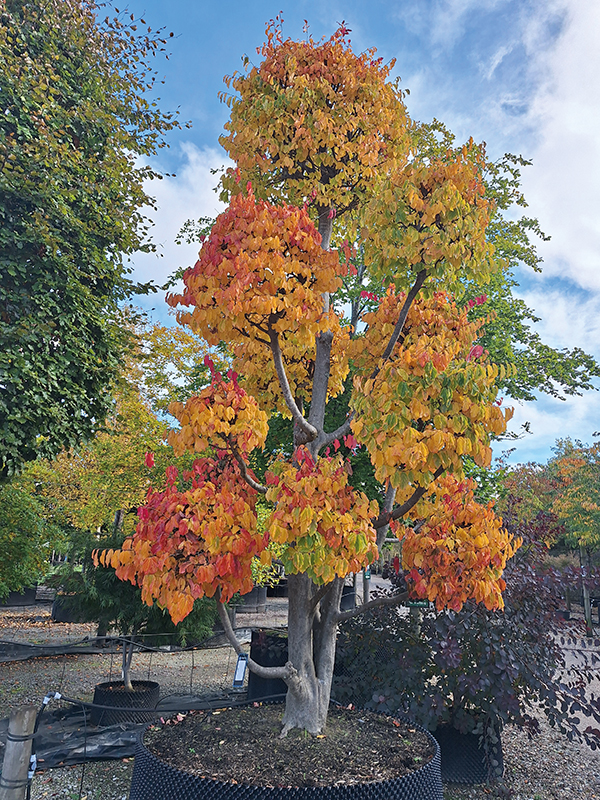
BEST FOR: EXTREME HEAT
Parrotia persica
Long living and spectacular, the Persian ironwood tolerates extreme cold but is happiest in warm micro-climates with good access to soil moisture. With eye-catching early spring flowers, mottled bark, and fine autumn colours, it has a long season of interest and strong, sinuous branches.
Height: 7 to 12 metres; Spread: more than 8 metres.
BEST FOR: ADAPTABILITY TO CLIMATE EXTREMES
Corylus colurna
RHS recommended AGM
Turkish hazel is one of the strongest contenders for best climate resilience, being able to withstand temperatures as low as -25C and extremely high figures in summer. It can also tolerate drought and water-logged conditions and the challenges of poor air quality, compacted soils, and exposed windy situations. ‘This species shows significant promise in managing climate-induced shifts [in the weather],’ says Eliot Barden. It could replace ‘less robust native species while offering the same opportunities for biodiversity'. It offers good shade, has impressive catkins in spring, and animals feed on the nuts.
Height: 17 to 22 metres; Spread: more than 8 metres.
BEST FOR: CARBON SEQUESTRATION
Zelkova serrata
RHS Recommended AGM
An East Asian deciduous species praised for its adaptability to heat, drought, and pollution in urban environments. A very effective, deep-rooted tree with high carbon sequestration value. As a large, spreading shade tree, it can contribute significantly to urban cooling. A member of the Elm family, the species will be contributing to the diversity of Ulmaceae in Britain, which has been lost in recent decades. Relatively small, serrated leaves create a light canopy, and narrow, more compact cultivars such as ‘Green Vase’ are becoming available.
Height: 12 to 17 metres; Spread: more than 8 metres.
BEST FOR: SUPPORTING BIODIVERSITY
Malus subspecies
Crab apples are amongst the highest value trees for biodiversity across the seasons. Majestic Trees highlights Malus ‘White Star’ (below, left) and Malus toringo ‘Scarlett’ as the two top cultivars for disease resistance, which is important as climate extremes increase susceptibility. Both varieties are ideal for small gardens. Also consider Malus baccata ‘Columnaris' as a useful choice for limited space, and Malus hupehensis RHS Recommended AGM as a versatile, reliable tree for urban and rural settings alike. Malus require plenty of sunlight and dislike coastal exposure.
Height: 4 to 10 metres. Spread; 4 to 8 metres.
BEST FOR: URBAN COOLING
Liriodendron tulipifera
A wind-resistant north American pioneer species, extremely proficient at capturing carbon, it has a high growth rate in climates with moist, cool-warm summers. A large, ornamental, parkland tree that requires generous root space but will cast ample shade.
Height: 17 to 22 metres; Spread: more than 8 metres.
BEST FOR: URBAN POLLUTION TOLERANCE
Koelreuteria paniculata
High temperatures and drought are not a problem for this small Chinese species once it is established. The abundant yellow, midsummer flowers give a beautiful display and provide nectar. These are followed by unusual lantern-like fruits that persist into the winter. Requires a light, open site for optimal growth, avoiding extreme wind exposure. Very tolerant of poor soils.
Height: 5 to 8 metres; Spread: more than 8 metres.
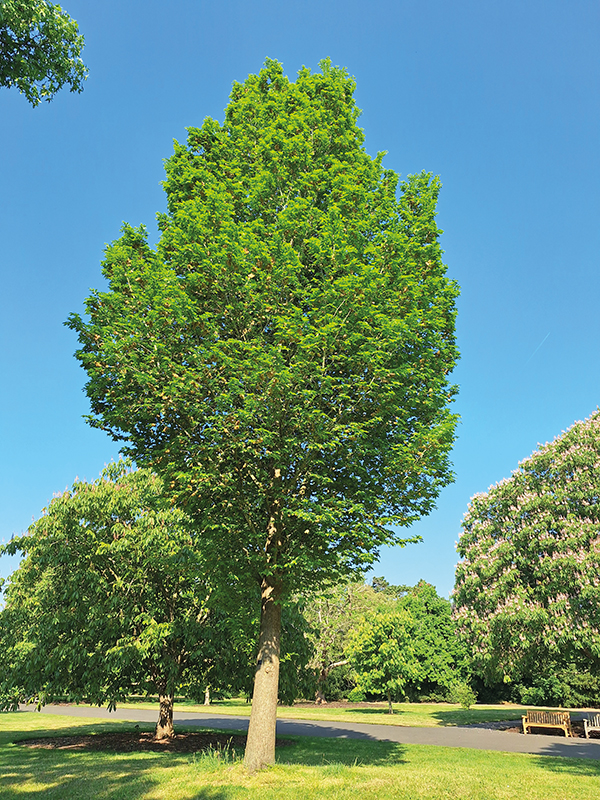
BEST FOR: ATMOSPHERIC POLLUTION AND COASTAL ENVIRONMENTS
Ulmus ‘Lobel’
The breeding of resistant elms has followed on from the devastation of Dutch Elm Disease. Diversity of Ulmaceae is required for safe-guarding future trees and this Dutch hybrid has characteristics that can manage shifting climatic conditions, including in coastal environments. Resilience to wind is a notable feature of this graceful, fast-growing variety.
Height: 17 to 22 metres; Spread: 4 to 6 metres.
ENDNOTE
1 Environment Agency, Chief Scientist’s Group. (2021). The state of the environment: the urban environment, (Updated 2023) gov.uk.
Main photograph, (London skyline) Getty Images/Richard Newstead
Photographs, (tree specimens) courtesy of Majestic Trees
SUBSCRIBE TO THE GARDEN DESIGN JOURNAL NOW
Take out an annual subscription, or you can purchase one as a gift for a friend.