The Garden of the Year 2026
This year's SGLD ‘Garden of the Year’ is a remarkable family garden designed by Tomoko Kawauchi MSGLD of Kawauchi Rowe. Praised by the judges as "an absolute masterpiece", the project transformed a hard landscaped plot into a richly planted, immersive garden full of character, atmosphere and thoughtful detail. Here Tomoko describes the thinking behind the garden.
All photographs in this interview are by Jason Ingram
1. The judges mentioned the "wonderfully modern approach" you bought to the garden. How do you define modern garden design, and what does it mean to you personally?
For us, modern garden design means freedom. It is not defined by a particular style, movement or passing trend. Rather, it is about creating a garden that is authentic to the way it will be used and to the atmosphere the client wishes to experience within it.
The most important part of the process is understanding what people are truly seeking. Often, the brief presented at the outset is only the surface of a deeper aspiration. Through conversation, questioning and observation, we try to uncover what the client is really looking for — whether that is calm, connection, refuge, sociability or a sense of belonging. A successful contemporary garden emerges from that understanding rather than from any predetermined aesthetic language.
2. The planting feels very abundant but also controlled, how did you strike that balance between wildness and structure?
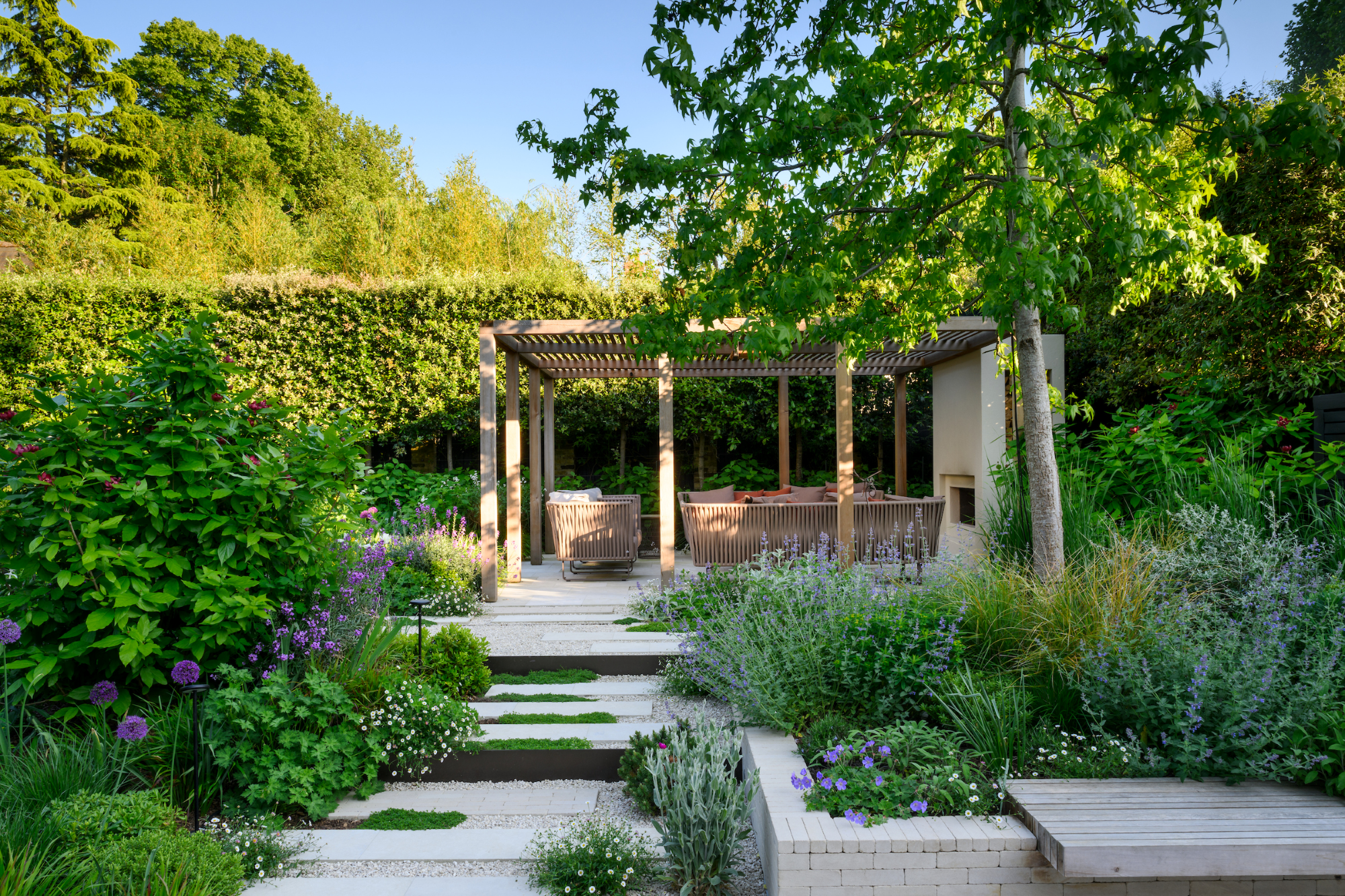
The idea of abundance was central to the planting concept from the very beginning. We wanted the planting to spill naturally from the upper level and cascade into the lower terrace beds, creating a sense of generosity and movement throughout the garden.
The balance between wildness and structure comes from carefully defining the edges. We paid particular attention to the transitions between planting and hard landscaping, using staggered stepping stones and articulated terrace edges to create a subtle framework. This allows the planting to feel free and abundant without becoming chaotic.
We also introduced moments of discovery within the planting. Around the trampoline, for example, we used wild strawberry (Fragaria vesca) among the groundcover species, creating a small area where children can forage, explore and engage with the garden. It brings a touch of wildness, but within a carefully considered structure.
3. The judges flagged this as a "complex build" — what were the biggest challenges you had to solve, and how did you overcome them?
Interestingly, the rear garden was relatively straightforward to resolve from a design perspective. The real challenge lay in the side garden.
These spaces were underused, yet we wanted them to contribute meaningfully to the overall experience of the garden. The site presented numerous constraints: mature existing trees, limited light levels, a substantial garden structure, fixed levels adjacent to the driveway and lightwell, as well as sensitive root zones that needed to be protected.
Balancing these practical considerations while introducing new functions required extensive exploration. We produced many iterations before arriving at the final design. In many ways, the solution emerged through a process of careful refinement rather than a single decisive gesture.
4. They specifically praised the partnership between you and the contractor — how did that relationship work, and how important is that collaboration to the final result?
The relationship between designer and contractor is absolutely fundamental. As a studio, we place enormous value on collaboration and seek to establish a close working relationship long before construction begins.
Often, we share ideas and aspirations during the design stage itself. It is essential that the contractor understands the vision behind the project — not simply the drawings, but the qualities and atmosphere we are trying to achieve. Equally, contractors bring invaluable practical knowledge, helping us understand the physical realities and limitations of a design.
The most successful projects emerge from this dialogue. Rather than compromise, it becomes a process of finding collaborative solutions that strengthen the work. Design is never a solitary activity. It is shaped through conversations with clients, contractors and craftspeople alike, and that collective process is one of the most rewarding aspects of the profession.
5. "Luxurious materials" and "thoughtful detailing" were both mentioned by the judges. Can you talk us through some of the specific material choices and why you made them?
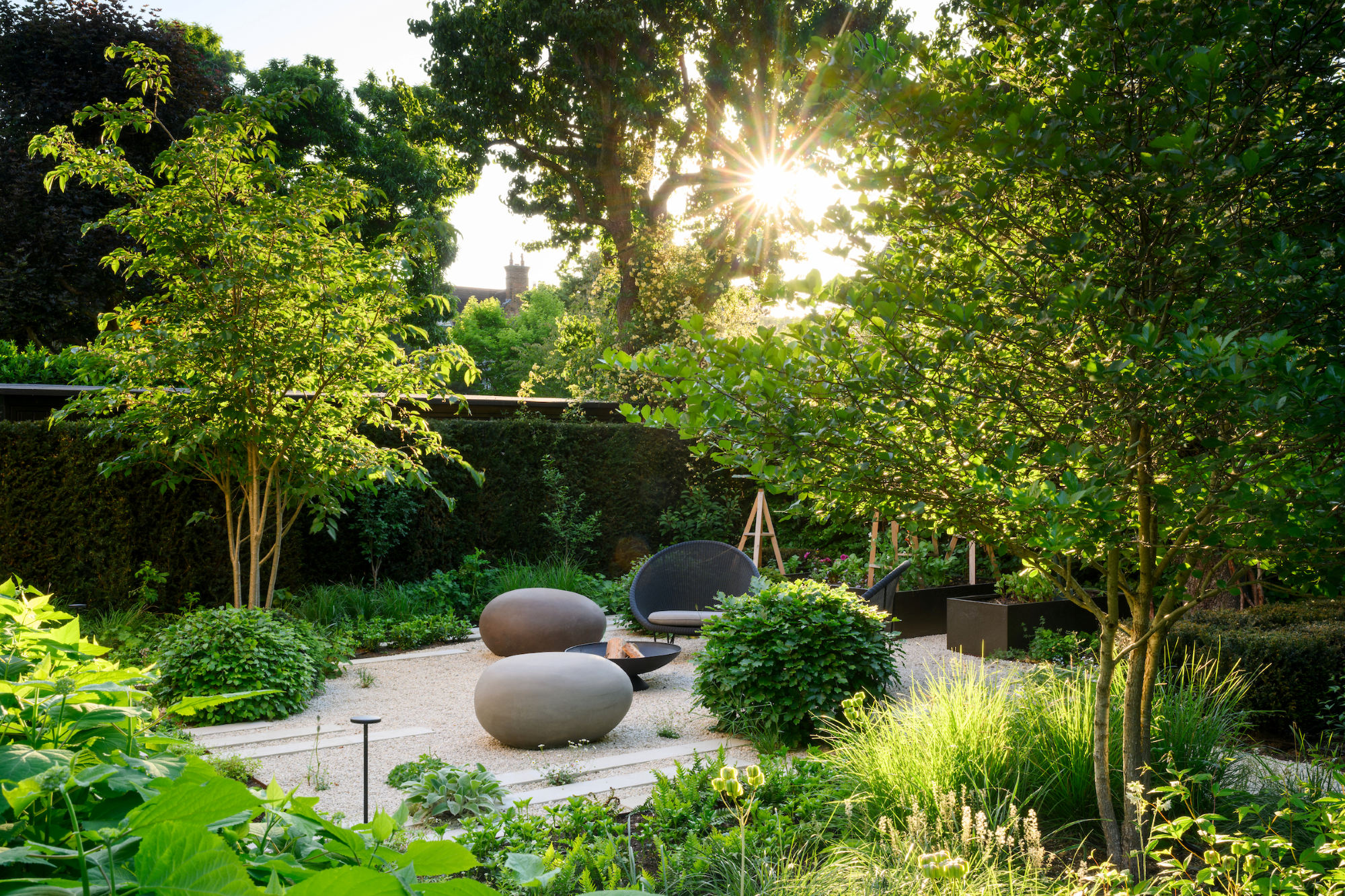
We never select materials simply because they are considered luxurious. Our first considerations are always durability, reliability and how a material will perform within the British climate.
For this garden, we specified Chicksgrove limestone in a calibrated finish alongside Luciano stackers in an etched finish. Both surfaces possess a subtle texture — enough to create warmth and tactility without becoming visually dominant.
What interested us was not overt richness but a sense of quiet material harmony. While colour was naturally important, we were particularly focused on achieving a consistent tactile quality across the garden. The nuanced textures encourage touch and interaction, contributing to an atmosphere that feels both refined and welcoming.
6. Is there a detail in this garden that most visitors wouldn't even notice, but that you're particularly proud of?
The craftsmanship throughout the project is exceptional, particularly the joinery delivered by Natural Spaces. However, the detail I am perhaps most pleased with is one that many visitors may never consciously notice.
During construction, soil excavated for the in-ground trampoline and new steps was carefully reused to create gentle mounds within the planting beds. These subtle changes in topography introduce instant height and depth to the landscape, helping to screen neighbouring areas while creating a more immersive planting environment.
Because the level changes are so understated, they often go unnoticed. Yet they play a crucial role in shaping how the garden feels and functions. It is a small intervention, but one that has a significant impact on the overall experience.
7. They praised the "skillful transitions" between spaces — how do you choreograph the way someone moves through and experiences a garden?
It is important to imagine every member of the household moving through the space — parents, children, guests, whoever will spend time there. In a way, you have to enter into each character and consider how they might pause, wander, gather or retreat.
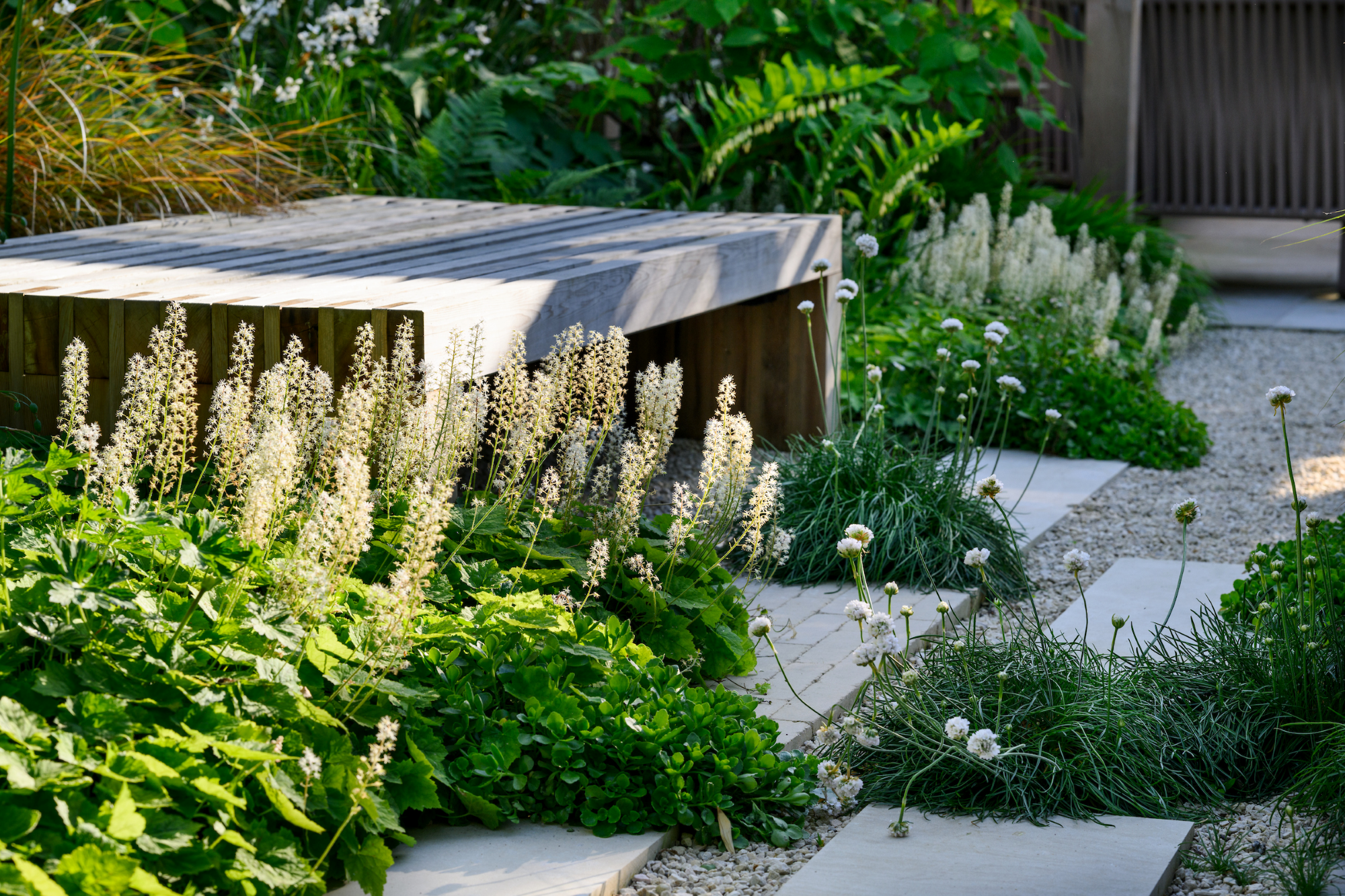
There is also room for a little twist. In traditional Japanese garden design, stepping stones are sometimes placed in a deliberately irregular or slightly uncomfortable rhythm. This slows the body down. It makes a person pause, adjust their pace and notice the garden from a particular viewpoint.
We used stepping stones throughout this garden, and their staggered arrangement is occasionally a little awkward by design. It is not about controlling movement exactly, but about choreographing it gently — guiding people towards certain views, moments and sensations.
8. One judge noted it was "beautifully engaging for children" — how do you design a garden that works for the whole family without compromising on aesthetics?
I still have an eight-year-old self somewhere inside me, and I think many adults do. We remember, instinctively, what made a garden magical when we were children.
Children do not necessarily need swings, climbing frames or obvious play equipment at home. Those things can be found in public parks. What children are often most fascinated by is much quieter: soil, worms, insects, small plants, grass seed heads, the sound of wind, light filtering through trees.
These are the things that draw them into their imagination. A child can become completely absorbed by the life of a garden if the garden is rich enough to invite that kind of attention.
As a studio, we do not usually encourage a garden to be designed around children’s structures. Instead, we try to create a beautiful garden for the whole family - one that children can lose themselves in, and adults can enjoy just as deeply. In that sense, there is no need to compromise the design.
9. The pergola with the outdoor fireplace is such a strong focal point. Was that the client's brief or your idea?
We have explored the combination of a pergola and outdoor fireplace in previous projects, and when we shared those examples with the clients, they responded strongly to the idea.
It makes sense to create a focal point within the garden: somewhere warm, cosy and slightly set apart. When you introduce a fireplace, you naturally want a sense of enclosure too - a place that holds warmth and gives people a reason to gather.
The overhead canopy helps create that feeling. In this garden, the addition of a side bench made the space feel even more intimate and comfortable. It is a simple composition, but it works because it answers both practical and emotional needs: warmth, shelter, focus and togetherness.
10. The tall hedging creates a really enclosed, private feel. Do you find clients increasingly want that sense of a garden as a sanctuary?
In this particular garden, the tall hedging in the rear garden was inherited from the previous design, as were the pleached trees. But yes, I do think clients increasingly want a sense of sanctuary.
In a town garden especially, enclosing the boundary is very powerful. It creates the feeling of a private world - almost an ideal Eden, cut away from the busyness outside.
A garden can become a magical place when the edges disappear, and the outside world is softened or screened. That sense of retreat is something many people are seeking now.
11. Looking at it now, is there anything you'd do differently?
After the garden was completed, there was a moment when the planting became more abundant than the client expected. Some of the plants began to spill over the edges of the path more than she wanted.
If we were to do one thing differently, we might make the path slightly wider. But, in truth, we also love that quality. There is something beautiful about planting that reaches beyond its boundary, touching you as you pass.
A garden should not feel too static or perfectly contained. That gentle brushing of plants against the body reminds you that the garden is growing and changing around you.
12. What's the one thing about this garden that a homeowner with a modest budget could actually steal and apply to their own space?
If you’re working with a modest budget, the most important thing to think about is sustainability — not simply in environmental terms, but in terms of longevity. There is little value in investing heavily in a garden that looks impressive on day one but struggles to adapt to the changing needs of the people who use it.
I often encourage clients to think about their garden in four dimensions: not only how it will function today, but how it might evolve over time. Consider how family members will grow, how lifestyles may change, and how different parts of the garden could take on new roles in the future. The most successful gardens are those that can accommodate change rather than resist it.
In this project, one example is the sunken trampoline, which was inherited from the original garden but repositioned as part of the new design. While it serves as a play feature today, the excavated space has been designed with a second life in mind. Once the children outgrow the trampoline, the area can be transformed into a sunken fire-pit garden, complete with built-in seating and surrounded by planting. Importantly, this future adaptation has already been considered within the wider masterplan, meaning the garden can evolve without requiring a complete redesign.
For anyone looking to make the most of a limited budget, that would be my advice: think long-term. Design for the life of the garden, not just for the moment of its completion.
Return to the Meet a Designer Hub